
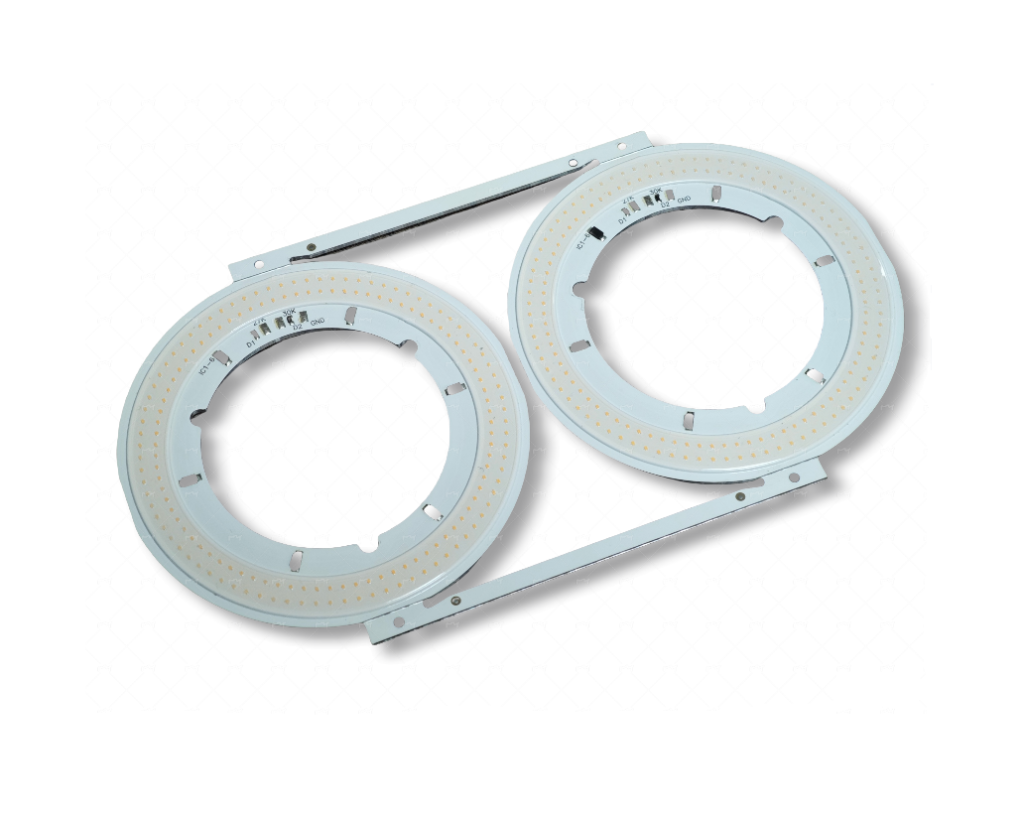
The root cause of COB-LED heat dissipation problems:
The working principle of COB-LED determines its unique structural characteristics, as it encapsulates multiple LED chips in extremely high density on a substrate. When these chips are in operation, a large amount of heat is generated due to the passage of current. Just like gathering numerous heat sources in a small space, if these heat sources cannot be exported in a timely and smooth manner, it will lead to a continuous increase in the junction temperature of the chip. The increase in junction temperature can lead to a series of serious problems:
Decreased light efficiency (light decay): Originally bright lights will gradually become dim, affecting the intensity and uniformity of the light, resulting in a significant reduction in lighting or display effects.
Color temperature drift (color distortion): The color of the light may deviate, and the originally pure white may appear yellowish or bluish, which can cause great inconvenience for occasions that require high color accuracy, such as stage lighting, photography lighting, etc.
Shortened lifespan (appr 50% reduction for every 10 ° C increase): Excessive junction temperature can accelerate the aging and damage of internal materials in chips, just like electronic products that are exposed to high temperatures for a long time, their lifespan will be significantly reduced, increasing usage costs and maintenance frequency.
How to customize COB LED products?>>
COB LED Heat dissipation solution:
High thermal conductivity substrate:
To improve the heat dissipation effect, ceramic substrates such as Al ₂ O3 can be used AlN, Thermal conductivity coefficient of 20-200 W/m · K) or metal substrate (copper substrate, thermal conductivity coefficient of about 400 W/m · K). Ceramic substrates have good insulation and high thermal conductivity, which can quickly dissipate the heat generated by the chip; Copper substrates, on the other hand, provide more efficient channels for heat dissipation due to their excellent thermal conductivity.
Copper coated ceramic substrate (DBC/DBA) is a more ideal choice. It cleverly combines the high thermal conductivity of copper with the insulation properties of ceramics, ensuring good heat dissipation while meeting electrical insulation requirements, making it highly suitable for high-power COB-LED applications.
Optimization of heat dissipation path:
Shortening the heat conduction path from the chip to the heat sink is the key to improving heat dissipation efficiency. By adopting advanced processes such as direct bonding technology, the thermal resistance of the intermediate layer is reduced, allowing heat to be transferred more quickly to the heat sink, like opening up a “green channel” for heat.
Integrated radiator:
Installing a finned radiator can increase the heat dissipation area and improve heat dissipation efficiency. The principle of a finned radiator is similar to the fins of a radiator, which accelerate the dissipation of heat by increasing the contact area with air.
Heat pipes or vapor chambers are also effective means of improving heat dissipation efficiency. Heat pipes utilize the phase change principle of the working fluid to quickly transfer heat from one end to the other; A uniform temperature plate can evenly distribute heat inside the plate, avoiding local overheating and improving overall heat dissipation performance.
al Interface Material (TIM):
The use of thermal interface materials such as high thermal conductivity silicone grease, graphene, or phase change materials can effectively reduce the contact thermal resistance between the substrate and the heat sink. These materials are like a “thermal conductive adhesive” that can fill the tiny gaps between the substrate and the heat sink, enhancing the thermal conductivity between the two.
Dynamic current control:
By using PWM dimming or constant current driving methods, COB-LED overload operation can be avoided, thereby reducing heat accumulation. PWM dimming can adjust the brightness of lights according to actual needs, while reducing unnecessary energy consumption and heat generation; Constant current drive can ensure stable current and avoid abnormal heating caused by current fluctuations.
Temperature feedback mechanism:
Integrated thermistor or infrared sensor, capable of real-time monitoring of changes in junction temperature. Once the junction temperature exceeds the set threshold, the system will automatically adjust the driving current, just like installing an “intelligent temperature controller” on COB-LED to ensure that it always operates within a safe temperature range.
Forced air cooling:
In enclosed environments with poor heat dissipation conditions, pairing with a small fan can enhance air convection and accelerate heat dissipation. The rotation of the fan can drive air flow, timely carrying away heat and preventing heat accumulation around the COB-LED.
Liquid cooling heat dissipation:
In ultra-high power scenarios such as car headlights and stage lights, due to the enormous amount of heat generated, traditional heat dissipation methods are often unable to meet the demand. At this point, water cooling or microchannel cooling systems play an important role. The water cooling system takes away heat through circulating water and has extremely high heat dissipation efficiency; The microchannel cooling system utilizes a small channel structure to increase the contact area between the coolant and the heating element, further improving the heat dissipation effect.
High thermal conductivity solid crystal adhesive:
The use of silver paste or nano silver sintered materials instead of traditional epoxy resins as solid crystal adhesives can significantly improve the thermal conductivity of the solid crystal adhesives. Silver paste and nano silver sintered materials have good thermal and electrical conductivity, which can better connect chips and substrates, while quickly conducting out the heat generated by chips.
High temperature resistant fluorescent layer:
To avoid carbonization failure of fluorescent powder caused by high temperature, silicone encapsulation can be used instead of organic silicon. Silicone has excellent high temperature resistance and optical properties, which can maintain the stability of the fluorescent layer in high temperature environments, ensuring the luminescence effect and service life of COB-LEDs.
Go To See Our Various Custom COB LED Products Video>>
Summarize:
COB-LED heat dissipation is a systematic engineering that requires comprehensive optimization from four aspects: materials, structure, drive, and environment. By reducing thermal resistance and improving heat dissipation efficiency, the stability of light efficiency can be significantly improved and the service life can be extended. The future development trend includes the further integration of integrated heat dissipation design (such as chip level packaging) and intelligent temperature control systems, which will provide stronger technical support for the application of COB-LEDs in more fields.