
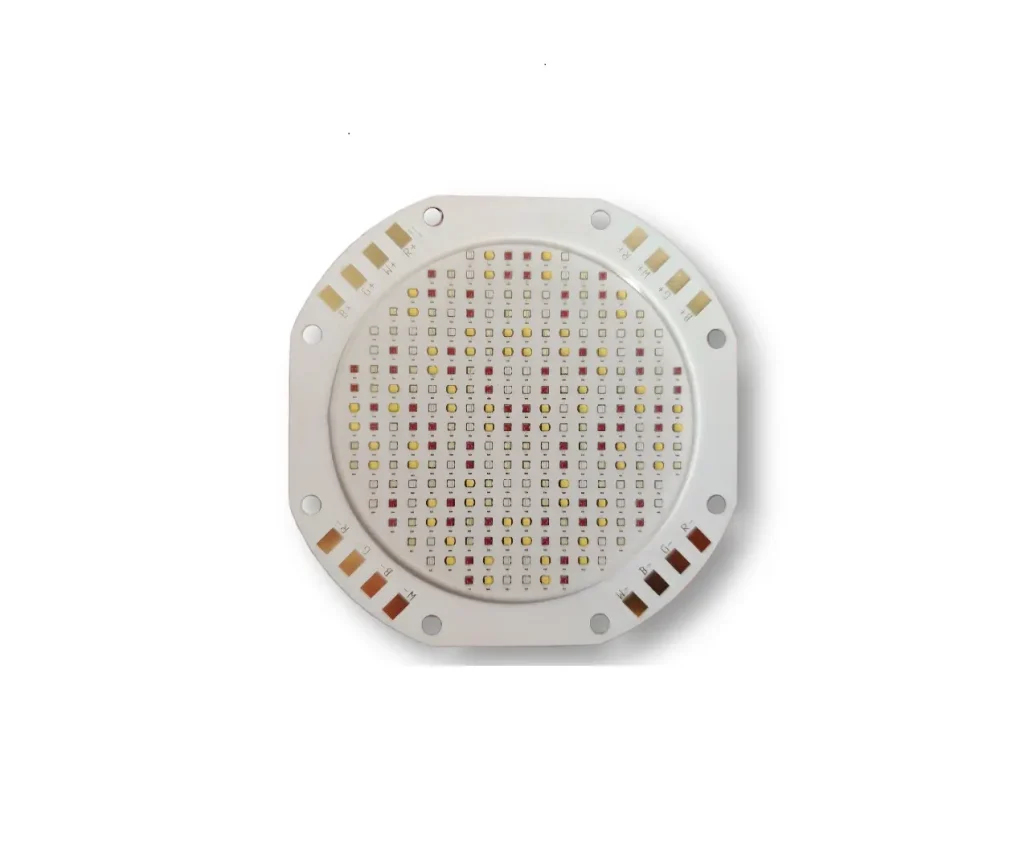
COB packaging is the process of directly mounting chips onto the substrate of a light source. When in use, the COB array is directly connected to the heat sink without the need for SMT surface assembly. The colloidal temperature of COB array can reach up to 125 ℃, while most chips can currently withstand a max junction temperature of no more than 125 ℃. Many manufacturers believe that if the temperature of the light-emitting surface exceeds 125 ℃, the temperature of the chip should be even higher, leading to concerns about the reliability of COB array.
How to customize COB LED products?>>
In response to this issue, researchers Eveliina Juntunen and others from the Finnish National Technical Research Center published a professional article titled “Effect of Phosphorus Encapsulation on the Thermal Resistance of a High Power COB LED Module” in the July 2013 issue of the IEEE journal “Components, Packaging and Manufacturing Technology”. The article conducted in-depth research on the temperature distribution and intrinsic mechanism of COB light sources.
The temperature of the fluorescent adhesive can reach 186 ℃, but the chip temperature is only 49.5 ℃. The lower temperature of the chip is because the chip is directly mounted on the aluminum substrate, and the heat of the chip can be quickly transferred to the heat sink through the substrate. Therefore, the chip temperature of the COB light source is much lower than the maximum junction temperature allowed by the chip.
When COB is working normally, the temperature of the fluorescent adhesive is higher than that of the chip because the number and arrangement density of chips in the COB light source are higher than those in ordinary SMD devices. The light energy density of the fluorescent adhesive is significantly higher than that of SMD devices. Both the fluorescent powder and silicone will absorb a part of the blue light and convert it into heat. In addition, the thermal capacity and thermal conductivity of silicone are relatively small, resulting in a sharp increase in the temperature of the fluorescent adhesive. Therefore, when the COB light source is working, the temperature of the fluorescent adhesive will be much higher than that of the chip.
The COB light source is packaged by directly attaching the chip onto the substrate, which has a lower thermal resistance than SMD devices and is beneficial for chip heat dissipation. In actual operation, the junction temperature of the chip is much lower than the maximum junction temperature allowed by the chip. Due to the multi chip arrangement of the light source, high lumen density output can be achieved on a smaller emitting surface.
When the light source is working, the fluorescent powder and silicone gel will absorb some of the light and convert it into heat. High luminous flux density output will cause the heat on the emitting surface to be more concentrated, resulting in a higher temperature on the emitting surface. If a thermocouple is used to directly measure the temperature of the light-emitting surface, the probe of the thermocouple will also absorb light and convert it into heat, resulting in a higher temperature measurement value.
Go To See Our Various Custom COB LED Products Video>>
Therefore, in order to effectively study the thermal distribution on the surface of COB light sources, it is recommended to use an infrared thermal imager for non-contact measurement. Due to the higher temperature of the light-emitting surface of COB light sources compared to ordinary SMD devices, the packaging process and material selection are more stringent, especially for the temperature resistance of phosphors and silicone.
ShiningEasy has summarized experience and improved production technology through years of production practice, providing effective technical guidance for COB heat dissipation. By continuously optimizing packaging technology and improving raw material standards, its normal operating temperature is far below the industry standard level, effectively controlling light decay. COB has better light efficiency and lifespan performance in practical applications.